
Once You Are Paid to Find Struggling Children, You Find Them Everywhere
A federal account named for school safety now routes most of its money to mental-health programs, and Congress made the spending legally binding, for programs no study shows make children safer or smarter. Follow the incentives and you see why the crisis never ends.

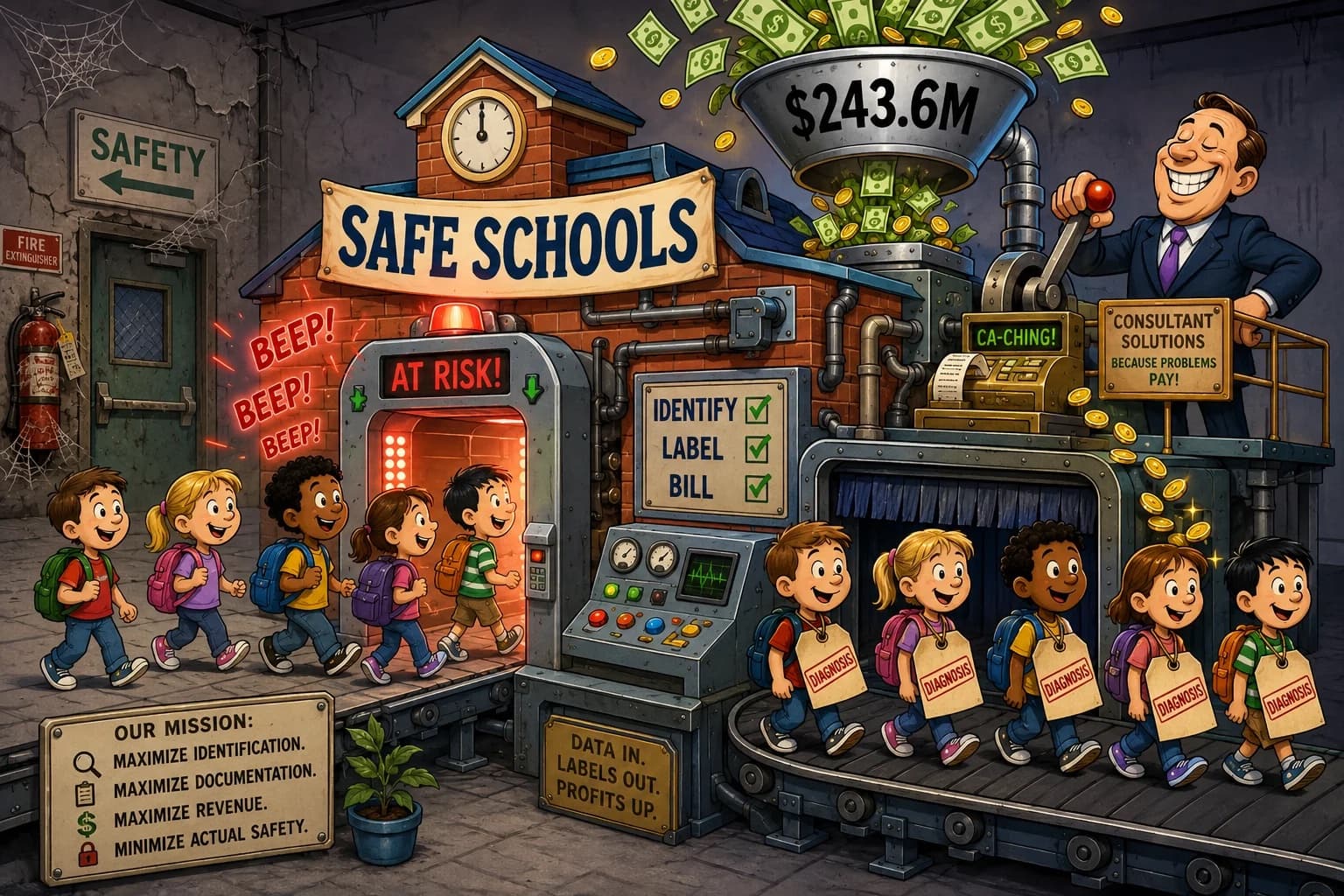
There is a line in the federal budget called "Safe Schools and Citizenship Education." Last week the House voted to spend most of it on neither.
Roughly 70 percent of the account's $243.6 million now flows to school-based mental-health grants, according to a City Journal analysis of the bill. And Congress did not merely suggest this. It wrote the figures into binding language, ordering the Department of Education to spend the money on those exact programs, whether it wants to or not.
Two of the grant programs being topped up have already had their legal authority expire. Congress is funding programs that, on paper, are not supposed to exist, at higher levels than before, and locking the spending in so no one can redirect it. That is not a glitch in the budget. That is the budget doing exactly what it was built to do.
Follow the money, not the mission statement
When a program cannot die even after its legal authorization does, stop reading the mission statement and start reading the incentives. The stated reason for a thing is almost always less revealing than the machinery paying for it.
So ask the question these debates always turn on: who benefits? Not the student, as the evidence will show. The people who benefit are the ones the money lands on, the screening vendors, the counseling contractors, the social-emotional learning consultants, and the grant administrators whose definition of success is next year's grant.
Youth mental health is real. Some kids are genuinely in crisis and need serious help. That is precisely what makes this such a useful banner to march under. No one wants to be the person who voted against sad children, which is exactly how a noble-sounding line item becomes impossible to kill.
A 90 percent miss rate is the business model
The engine of the whole enterprise is universal screening: run every child through a questionnaire and see who flags. It sounds responsible. The trouble is that universal screening produces up to 90 percent false positives.
For every genuinely struggling child it catches, it flags around nine who are fine. In almost any other field, a 90 percent error rate would shut a program down. Here it is the product.
A false positive is not a malfunction. It is a customer. Each flagged child becomes a referral, a billable screening, a counseling slot, and a fresh data point proving we need more screening next year. Take away the false positives and there is hardly a program left, only the small number of genuinely struggling kids who needed help in the first place.
Imagine a metal detector tuned to beep at belt buckles, operated by the same company that sells the detectors and bills for every beep. You would never hear the end of the beeping, and you would be told the constant beeping proved how dangerous the room had become.
How an ordinary childhood became a line item
Once you are paid to find struggling children, you start finding them everywhere. A bad week becomes "early intervention." Ordinary hardship gets upgraded to "trauma." A program designed for genuine emergencies quietly stretches until sadness itself looks like a diagnosis in waiting.
The longer-term research is not kind to any of this, and City Journal runs through it. A 2018 systematic review found the evidence weak and low quality. A 2025 assessment of universal prevention found it null or even harmful. A gold-standard trial found that more school mental-health services produced mainly more use of those services, with no gain in test scores or attendance. A multiyear effort in Toronto produced more diagnoses and more medicated kids, and nothing academic to show for it.
What these programs reliably produce is not better students or safer schools. It is more clients, the one number that always goes up.
Radical healing, zero math
If screening is the front door, "trauma-informed" instruction is what gets sold once you are inside. And this is where the clinical vocabulary stops covering for the politics.
Look at the study California reached for in its 2023 math framework to justify "trauma-informed pedagogy." As Max Eden documented, a researcher observed a "Social Justice Mathematics" class in which a teacher converted a number-line exercise into a map of a "food desert," then played students a video of a single mother who could not afford groceries.
The children were asked how the video made them feel. One broke down in tears. Another wrote that he felt "sad and worried" and "mad."
Another decided the government should intervene. Several committed themselves to activism. The researcher logged all of this as "radical healing."
Did anyone check whether the kids learned more math? No. The study gathered no achievement data at all. It noted instead that all nine students passed and enjoyed the activities. This was the evidence the nation's largest state cited when instructing teachers how to teach mathematics.
That is the whole trick in one example. "Trauma-informed" is the label that lets a single public dollar buy a diagnosis and a worldview at the same time. The wellness banner is what makes the politics tax-deductible.
The safety account that skipped the safety
Whatever the "Safe Schools" account is buying, it is not safety. The things that actually make a school unsafe, discipline nobody enforces, kids checked out and falling behind, chronic absence, buildings falling apart, are not feelings problems, and no questionnaire touches them.
It is the policy version of sending a counselor to a burning building. Real emergencies exist. This is simply not the tool for them, and the pretense drowns the few genuine cases in belt-buckle beeps.
What would actually help, and who decides
The fix is almost insultingly simple. Fund the account's actual name. Spend on real safety and on targeted care for the small number of children who truly need it, instead of running every child through a net designed to catch nine bystanders for each kid in trouble.
Let the expired authorities stay expired. Strip the binding language so the Education Department can move money away from programs that cannot show a result. And reinstate the one evaluator with both the standing and the incentive to get a child right: the parent. A teacher is not a therapist, a questionnaire is not a diagnosis, and a school is not a clinic, no matter how much money flows toward pretending otherwise.
The crisis is the customer
None of this endures because it works. It endures because everyone inside the machine is paid by the existence of the problem rather than its solution. A system rewarded for finding sick children will keep finding them, and will never announce that the kids are basically fine.
Even this bill arrived dressed as fiscal discipline, full of language about cutting waste and ending progressive overreach. The same committee that promised to hand education back to the states still found the money for school mental health, and still bolted it down so the next administration cannot touch it. The crisis is bipartisan because the incentive is bipartisan.
So perhaps the account is named correctly after all. It really is teaching citizenship. The lesson is how to spend an entire childhood as a paying client of the people who are paid to keep you one.

About the author
Dyson Wu
Education and Incentives Columnist
Examining the stories schools tell, the incentives behind them, and the consequences parents and students are expected to ignore.