
A Portland School Teaches Five-Year-Olds Their Parents Are Optional
A Portland school counselor wrote a cheerful picture book teaching kids as young as five that family is something you pick. "Chosen family" was built for the truly abandoned. Aimed at kindergartners who are loved at home, it quietly teaches that mom and dad are optional.

A five-year-old cannot choose his own bedtime. He cannot choose his vegetables, his shoes, or how the cartoon ends. Ask him to pick a snack and he will stand at the open pantry until the milk turns warm. That is not a knock on five-year-olds. It is the whole job description of being five.
So you have to wonder who looked at that child and decided what he urgently needed was a book about choosing his family.
Her name is Madi Bourdon, and by her own testimony to the Oregon Legislature she is "an elementary school counselor in Portland Public." She wrote a picture book called A Kids Book About Chosen Family. The publisher says it is for kids aged five to nine. Target shelves it under books for ages three to five.
Three. A child who is three years old can now find, on a Target shelf between the board books and the bath toys, a hardcover teaching him that family is something you select.
"Chosen family" was built for the abandoned
Here is the part the outrage usually races past. Chosen family is a real thing, and at its root it was an honorable one.
The phrase belongs to people who were genuinely thrown away. Gay men dying in the 1980s, nursed by friends because their own parents would not come to the hospital. The disowned, the orphaned, the kid whose father really did mean it when he pointed at the door. For a person the world has actually cast out, the friends who step in are not a consolation prize. They are a rescue, and nobody with a pulse says otherwise.
But look hard at who that lifeboat was built for. It was built for people already in the water, not for kindergartners sitting at their own kitchen tables, eating dinner cooked by the very people the book invites them to reconsider.
She is handing the lifeboat to children who are not drowning.
An audit with crayons
The book itself sounds gentle, and that is the whole trick. A chosen family, it explains, is simply "a family you choose," made up of the people who "make you feel the safest and bravest." Sweet. Harmless. The lettering is adorable.
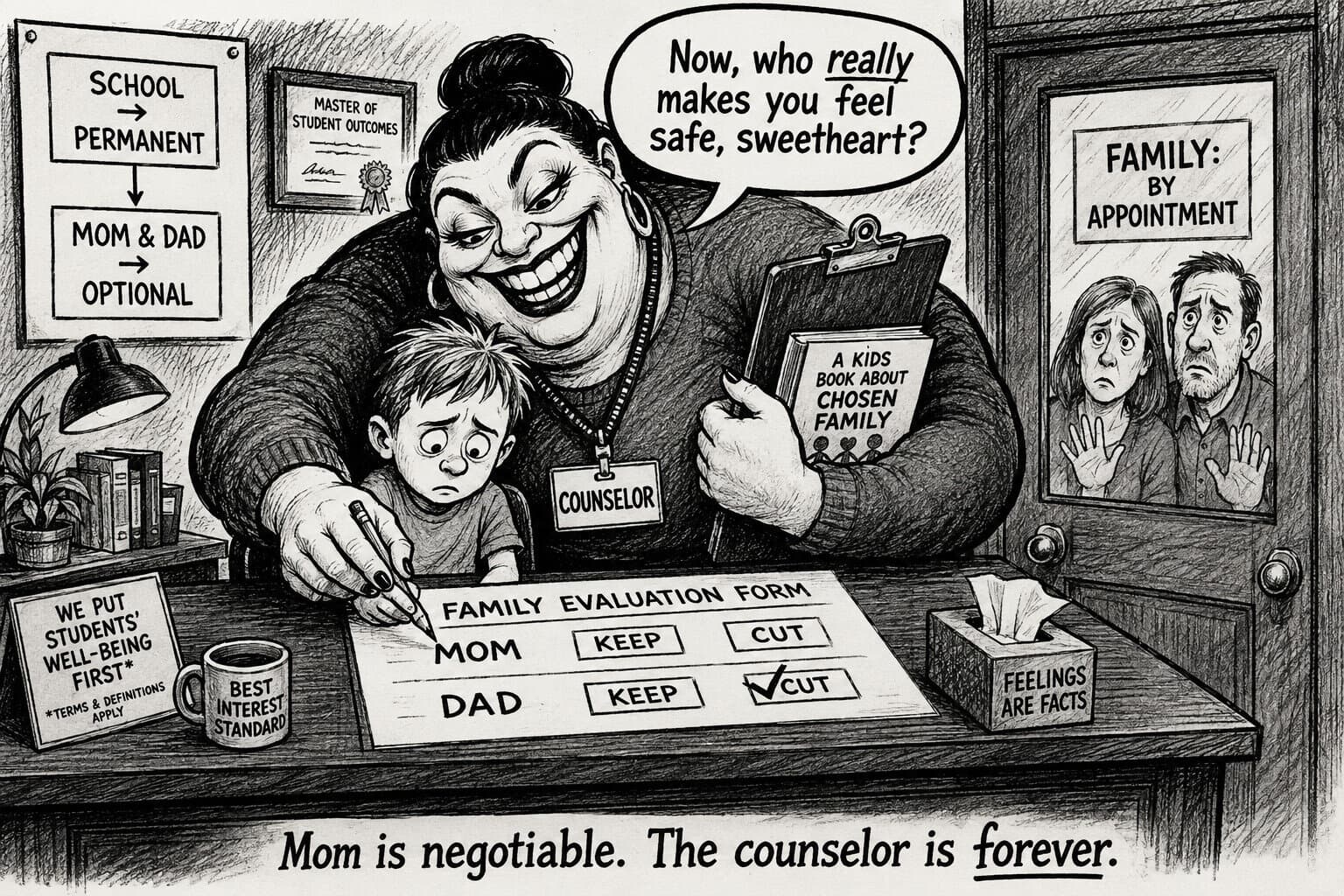
Now read it the way a parent should. You are telling a small child that family is a thing he picks, then inviting him to rank the candidates by who makes him feel safest. You have asked a kindergartner to take inventory of the adults who love him and sort them into keep and cut.
That is not a bedtime story. That is an audit. The child does the counting, and the counselor keeps the clipboard.
Teach a child to look for the exit and he will find one
A child taught to look for the way out will sooner or later decide he needs one.
You cannot ask a kindergartner to weigh whether his parents "accept him for who he is" without planting, in a mind far too young to carry it, the suspicion that one day they might not. The question itself is the damage. It hands a child a doubt he did not arrive with and was in no hurry to go find.
And here is the tell, the detail that gives the whole project away. In promoting the book, Bourdon put it plainly: "members of one's biological family are not always the people who are family in the ways that matter." Parents, in other words, become a variable.
Notice who is never on that list. The counselor is never optional. The school is never the relationship a child is gently encouraged to reevaluate. No picture book ends by asking the kindergartner whether the adult who handed it to him is really family "in the ways that matter."
The replaceability runs in exactly one direction. Mom is negotiable. The institution is forever.
Bourdon has been candid about who the book is for: the child whose "given family doesn't fully understand them or accept them." Given family. As though the people who gave a child his life, his name, and his supper were a factory setting he is free to upgrade.
Nobody prints the real subject on the cover, but everybody knows it. A book like this is aimed first at the child wrestling with something at home, gender most often, the kid readiest to hear "they do not accept you" and believe it. Start there if you want. The logic does not stay there. Once family becomes a thing a child is taught to grade, every child starts grading.
We have run this experiment before
If any of this feels new, that is only because the marketing is. The idea is nearly two centuries old.
In 1848 a preacher named John Humphrey Noyes founded a utopian commune at Oneida, in upstate New York. The Oneida Community believed a great many strange things, but one conviction sat at the dead center of it: that exclusive love was selfish, and that a mother's private devotion to her own child was a danger to the group.
So they engineered it out. Children were raised in common in a wing of the great house. When the community decided a particular mother and her particular child were bonding too closely, it separated them on purpose, to stop the affection. Exclusive attachment even had a name there. They called it "selfish love," and they would criticize it out of you, in front of everyone.
One of those children grew up to write a memoir about being raised by a committee instead of a mother. Pierrepont Noyes called it My Father's House. The title is the entire review.
Oneida at least had the nerve to run its experiment on its own members, in the open, on its own land. This version arrives in a cheerful hardcover, aimed at other people's three-year-olds, and Target will have it on your porch by Thursday.
What a counselor is actually for
None of this means you storm the Target. The book is not contraband, and pretending a single picture book can dissolve your family hands it more power than it has earned. It means you read what your child brings home from the counselor's office the way you check his backpack and his lunch. Then ask a sharper question at the next conference: what is on the counselor's shelf, and can I say no to it? The right to review the classroom curriculum should not stop at the counselor's door.
And it means we should be willing to say the plain thing out loud about the job. A school counselor exists to take a hurting child and send him back toward his family steadier than he arrived. Not to audition for the part. The moment a counselor casts herself as the better option, she has stopped counseling and started recruiting.
First, demote the parent
Get between the parent and the child. That is where it always starts, from the commune to the Target shelf, and it is no accident that it keeps coming back for the youngest kids in the building.
The family is the one institution no government founded and no committee can fully run. A child who is loved at home without conditions is very hard to recruit, because he already belongs to someone. So step one never changes: teach the child the belonging was optional all along.
Which brings us back to the boy at the pantry, the one who cannot pick a snack to save his life.
He cannot choose his bedtime. He cannot choose his shoes. He is, gloriously, five years old. He is not equipped to choose his family, and he does not need to, because his family already chose him, the day he showed up, before he had done one single thing to deserve it.
The only person in the building who gains anything by telling that child otherwise is the one holding the clipboard.

About the author
David Whitlock
Parental Rights Columnist
Reading the fine print your child's school hopes you skip, on one stubborn conviction: parents, not institutions, hold the final say over their own kids.